Parsers
2026-11-18
notes / Compilers
Slides
Top Down Parsing
Eliminating Left Recursion
replace
E : E + T | T
with
E  : TE'
E' : +TE' | eps
Left Factoring
replace
S  : if (expr) S else S
   | if (expr) S
   | other
with (take common part out)
S  : if (expr) S S'
   | other
S' : else S
   | eps
Recursive Descent
import re

def tokenize(expression):
    """
    look for numbers or brackets or operators
    """
    token_pattern = r"(\d+|[()\^+\-*/])"
    tokens = re.findall(token_pattern, expression)
    return tokens

# parse functions for each non terminal
def parse_factor(tokens):
    """
    F -> (E) | number
    """
    token = tokens.pop(0)
    if token == "(":
        result = parse_expression(tokens)
        # HACK: prolly should check below statement
        tokens.pop(0) # get rid of )
        return result
    else:
        return float(token)

def parse_exponent(tokens):
    """
    X -> F ^ X | F
    """
    left = parse_factor(tokens)
    while tokens and tokens[0] == "^":
        op = tokens.pop(0)
        right = parse_exponent(tokens)
        if op == "^":
            left **= right
    return left

def parse_term(tokens):
    """
    T -> X*T | X/T | X
    """
    left = parse_exponent(tokens)
    while tokens and tokens[0] in "*/":
        op = tokens.pop(0)
        right = parse_exponent(tokens)
        # NOTE: backtracking happening here
        # to eliminate start predicting shit (LL(1))
        if op == "*":
            left *= right
        else:
            left /= right
    return left

def parse_expression(tokens):
    """
    E -> T + E | T - E | T
    """
    left = parse_term(tokens)
    while tokens and tokens[0] in "+-":
        op = tokens.pop(0)
        right = parse_term(tokens)
        if op == "+":
            left += right
        else:
            left -= right
    return left

def evaluate_expression(expression):
    tokens = tokenize(expression)
    result = parse_expression(tokens)
    return result

expr = "init"
while expr:
    try:
        print("parser: ", end='')
        expr = input()
        print(evaluate_expression(expr))
    except EOFError:
        print()
        print("parser: exiting")
        break
First and Follow sets
First :
"""
A := BC
"""
if eps not in first(B):
    first(A) = first(B)
else if eps in first(B):
    first(A) = (first(B) - {eps}) U (first(C))
Follow:
"""
A := BC
"""
follow(C) = follow(A)
if eps not in follow(C):
    follow(B) = first(C)
else if eps in follow(C):
    follow(B) = (first(C) - {eps}) U (follow(A))
LL(1) Grammars
- left to right leftmost derivation with 1 lookahead token
- A grammar is LL(1) iff whenever
A → α | β are two distinct productions, the following three conditions hold:
- For no terminal
a do both α and β derive strings beginning with a.
- At most one of α and β can derive the empty string.
- If β derives the empty string, then α does not derive any string beginning with a terminal in FOLLOW(
A).
Likewise, if α derives the empty string, then β does not derive any string beginning with a terminal in FOLLOW(A).
for each production "A -> a":
    for each terminal "a" in first("A"):
        M["A"]["a"] = "A -> a"
    if eps in first("A"):
        for each "b" in follow("A"):
            M["A"]["b"] = "A -> eps"
example 1
S : +SS
  | *SS
  | a
| S |
S -> a |
S -> +SS |
S -> *SS |
|
example 2
S : (S)S
  | eps
| S |
S -> (S)S |
S -> |
S -> |
Bottom Up Parsing
Shift-Reduce Method
- Shift: shift the next input symbol onto the top of the stack
- Reduce: the right end of the string to be reduced must be on the top of the stack. Locate the left end on the stack and replace with appropriate non-terminal
- Accept: announce successful completion of parsing
| $ |
a * a $ |
shift |
| $ a |
* a $ |
reduce F -> a |
| $ F |
* a $ |
reduce T -> F |
| $ T |
* a $ |
shift |
| $ T * |
a $ |
shift |
| $ T * a |
$ |
reduce F -> a |
| $ T * F |
$ |
reduce T -> T * F |
| $ T |
$ |
reduce E -> T |
| $ E |
$ |
accept
|
- Bottom of stack always has $
- End of input always has $
not good with ambiguous grammars
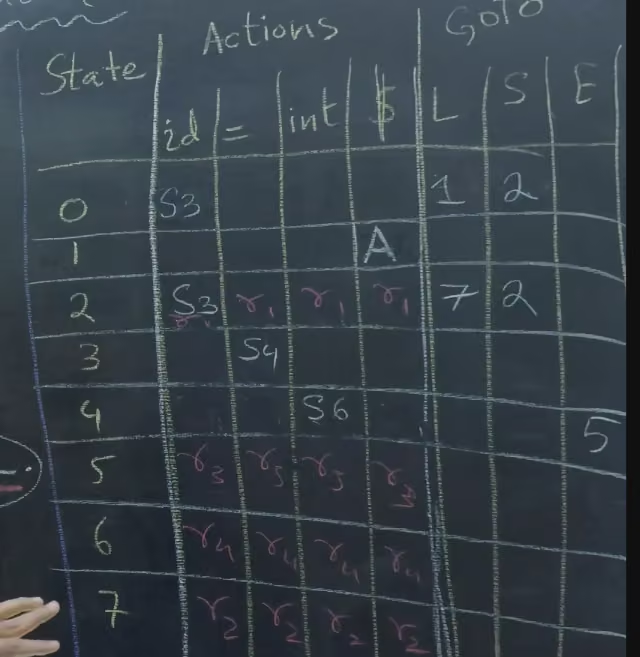
LR Parsers (LR(0))
parsers don't lookahead, so you reduce on every input token for a state
Simple LR Parsers
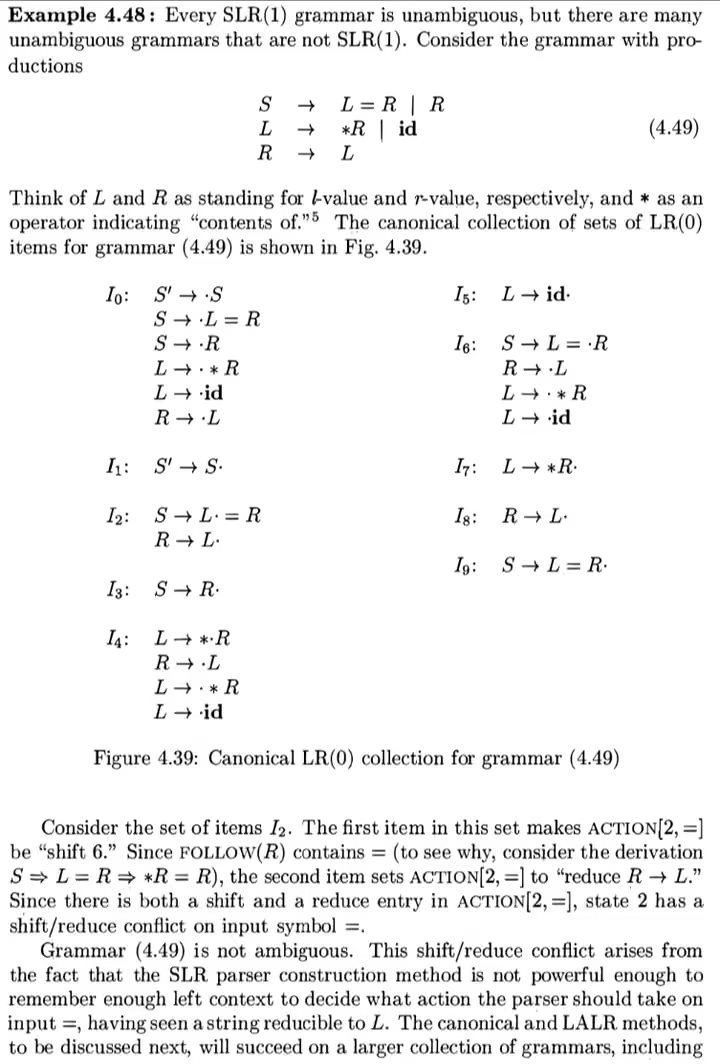
Now you are looking ahead one token. So you will only reduce when you encounter symbols in the follow set of the required non-terminal, instead of filling up every cell.
CLR Parsers
Example of LR(1) parser. So you make LR(1) automaton which includes a lookahead token derived from the first/follow sets
similar to SLR parser but a bit more specific. Also takes a lot more memory and everyone hates it
LALR Parsers
its preferred over SLR just because of this lol
linked from