Data Encryption Standard
2026-11-18
notes / Cryptography / Block Ciphers
DES is the best studied symmetric key algorithm
Overview
Fiestel Network paradigm of block ciphers
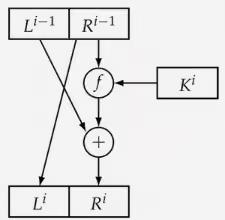
advantageous since encryption and decryption are very similar
thing of as a pseudorandom generator
each round bijectively maps input to output even if is not bijective (it is surjective)
Internal Structure of DES
Initial and Final Permutation
and add no additional security but are 2 bitwise permutations before and after the feistel network
The -function
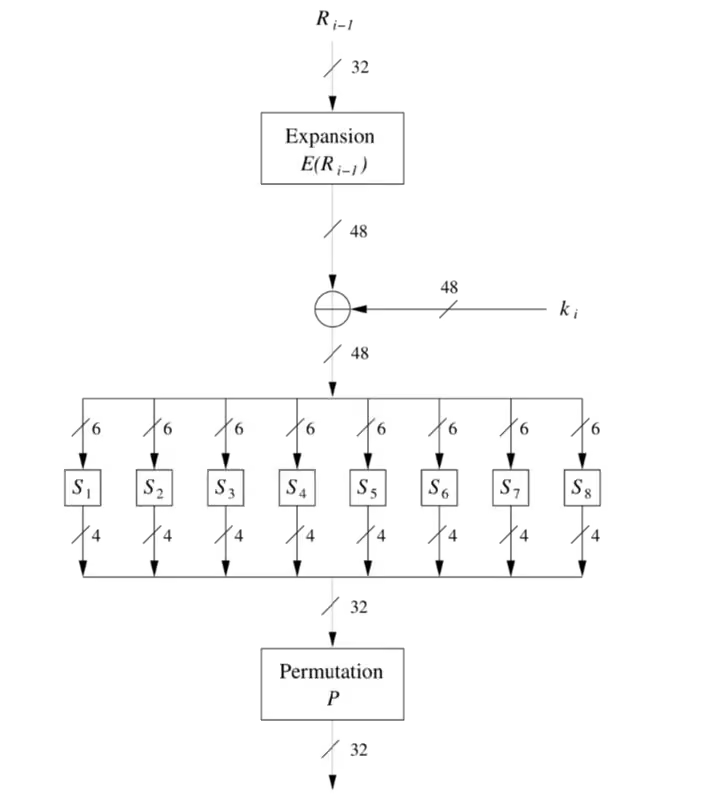
E-box:
- increases the diffusion behaviour of DES since certain input bits influence two different output locations
S-box: all S boxes in a round are different
- core of the cryptographic strength
- only non-linear element and provide confusion
- criteria
- no single output bit should be too close to a linear combination of the input bits
- if the lowest and highest bits of input are fixed and the four middle bits are varied, each of the 4-bit output values must occur exactly once
- if two inputs to an s-box differ in exactly one bit their outputs must differ in at least two bits
- If two inputs to an S-box differ in the two middle bits, their outputs must differ in at least two bits.
- If two inputs to an S-box differ in their first two bits and are identical in their last two bits, the two outputs must be different.
- For any nonzero 6-bit difference between inputs, no more than 8 of the 32 pairs of inputs exhibiting that difference may result in the same output difference.
- A collision (zero output difference) at the 32-bit output of the eight S-boxes is only possible for three adjacent S-boxes.
- non linearity
P-permutation: introduces diffusion
- ensures by end of 5th round every bit is a function of every plaintext bit and every key bit
Key Schedule
- derives 16 rounds keys of 48 bits from 56-bit master key (every 8th bit is used as odd parity bit over previous 7 bits for total 64-bit master key)
- initial permutation
- split into two halves and
- start 16 round key schedule
- with each round the two halves are cyclically shifted by 1 bit id (round index) is a perfect square
- other wise rotated left by 2
- total rotation positions are which gives us and same for (this is useful for decryption)
- Each round key comes from a permutation on given by (same permutation)
Decryption
- essentially same as encryption, just key schedule needs to be reversed
Reversed Key Schedule
from generate
and the remaining can be derived with right shift on
linked from