Set Sizes
2026-11-18 · abstract-algebra
notes / Discrete Structures
Discrete Structures
Best Resource: Topology, University of Toronto
Finite and Infinite Sets
Size of a set: The size of a set can be defined in many ways. The most common would be the number of elements in the set
Finite Set Infinite Set
Countable Sets
Motivation
In many areas of math we deal with a lot of infinite, and it becomes important to know when some are larger than others
Countably infinite sets are "small", and in fact are the "smallest infinite sets". They become convenient because you can list their elements, and thus use them for inductive proofs.
Counting
With finite sets we take counting for granted: we say that there are 3 birds, or 7 elements etc. But in math counting is defined as a process of comparing sets.
Say you have a hats, and b people. You start placing your hats on the people, and thus you can compare if you have more hats, or more people.
Set Size: Given two sets and we say that if there exists an injection (one-to-one) or equivalently if there exists a surjection (onto) if there is an injection from to but NO surjection from to then we can say
Now what would could we say if there were both injections as well as surjections from ?
Theorem: Given sets and ; if and only if there exists a bijection (one-to-one and onto)
Proving this uses a very useful Proof Techniques called the "back-and-forth argument"
Countability
Countable Sets: A set is said to be countably infinite if and countable if Note: is countable because the empty function is an injection
The intuition behind this should be that if you can list ALL the elements of in a list as shown then is countably infinite
then you can construct the bijection making
Some Results on Countable Sets
Property 1: Let be a countably infinite set and be an infinite subset of . Then is countable.Proof: Let be the bijection proving is countable. Prove that: there exists a bijection
Let That is, is the smallest number that got mapped into B by the bijection as
Proof by induction:
base case: define such that
inductive step (strong induction): assume we have defined . Then let
we can then define and continue like this by induction to map all elements in B.
Property 2: Let and be countable sets, then is also countable
We can see this from an image proving is countable
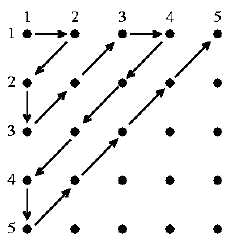
or more rigorously let be which is injective by the uniqueness of prime decompositions
Property 3: A countable union of countable sets is countable. i.e. if are countable sets then is countablelet be a bijection witnessing that is countable, and define by
Uncountable Sets
another good resource: JL Martin
Cantor's Diagonalization Proof: is uncountable
This is a proof by contradiction
let us assume that is countably infinite. And every can be represented as
let us list the real numbers as
this gives us a table like 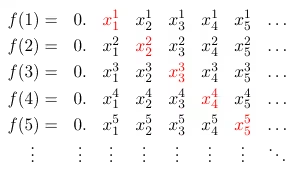
we can now construct a number that can not be on our list, which will contradict the assumption that is a bijection
let
now can not be the first number as or the second number and so on, essentially can not be in the table we constructed, thus can not be a bijection and is uncountable
From this we can prove that is uncountable
is uncountable: we need a bijection . is a bijection from and is a bijection from . Thus is our required bijection.
is the required bijection
Power Set Theorem:
Prove that can NOT be surjective define a set
assume is surjective now so let .
- if => => contradicting the assumption that f is surjective
- if => => also contradicting itself can not be a surjection
there are infinitely many sizes of infinity
linked from