Network Flow
2026-11-18
Network Flow
Two major problems
- Finding Maximum Flow
- Finding a Minimum Cut
Max-Flow Min-Cut Theorem
The maximum value of an s-t flow is equal to the minimum capacity over all s-t cuts.
https://www.youtube.com/watch?v=EGDokIJWrQU
- flow leaving source is same as flow leaving cut which is capacity of cut
Ford Fulkerson Method
def ford_fulkerson(G, s, t):
    G_f = residual_graph(G)
    f_e = 0 for e in G_f.e
    max_flow = 0
    while st_path = find_path(G_f):
        bottleneck = min_e(G_f) # min residual capacity
        # augment residual network
        for e in st_path.forward_e:
            e += bottleneck
        for e in st_path.reverse_e:
            e -= bottleneck
        max_flow += bottleneck
Termination
terminates with a valid flow
max_flow is always a valid flow
- the augmenting of the path ensures that
in = out for all vertices
max_flow is always an integer
bottleneck >= 1 for every iteration and since only finite flow can escape it will eventually terminate
Optimality
for any optimality problem
1. identify optimality conditions
2. design an algorithm that terminates with optimality conditions
Ford-Fulkerson Optimality Condition
if is a flow in such that the residual network has no path, then the is a maximum flow
there is no augmenting path therefore there is no flow from
and the algorithms necessarily terminates with this condition
Complexity
Running time is of the order
Does Ford-Fulkerson run in polynomial time in the size of the input ()
No. If max capacity is the algorithm can still take iterations
- each edge weight takes bits to represent
- input size =
- running time is exponential in size of but polynomial in the rest so its called pseudopolynomial
- if the running time is polynomial in magnitude but not size of input parameter
Edmonds-Karp Algorithm
use BFS to find augmenting path. Why? Ford Fulkerson worst case occurs when every time your bottleneck is very small. For larger bottleneck you want to take fewer edges. BFS naturally will find shortest edge path and remove dependency on for time complexity.
Dinic's Algorithm
and reduces to on bipartite graphs
- build level graph to choose edges that make progress towards the sink using BFS.
- If the sink was never reached while building the level graph then stop and return the max flow
- using only valid edges in the level graph do multiple DFSs from until a blocking flow is reached.
- repeat
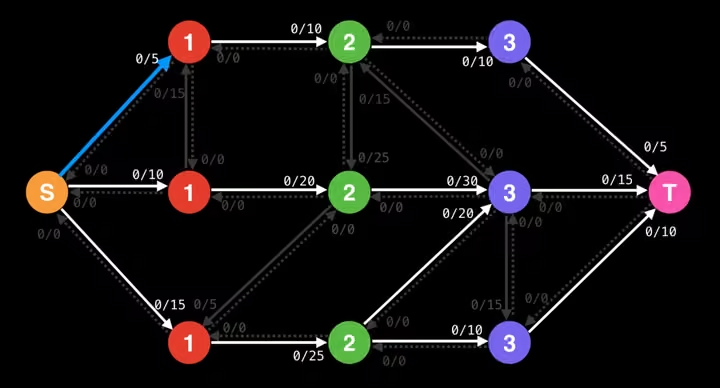 first iteration level graph
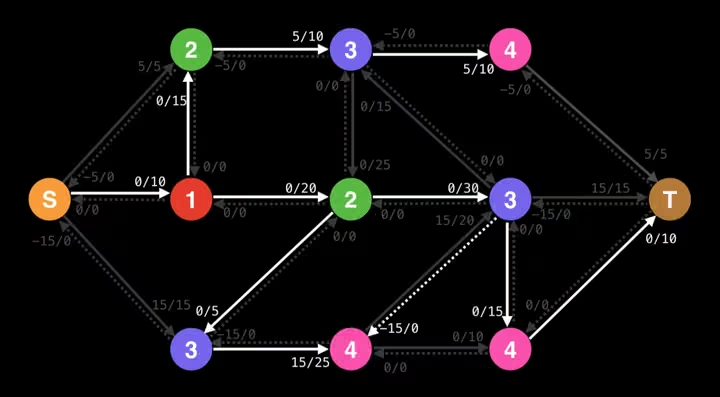 second iteration level graph
Push-Relabel Algorithm
all you have: https://www.youtube.com/watch?v=0hI89H39USg
- preflow: just push as much flow as you can
- excess: leads to excess obv
- height: raise height so that you can only push downhill
def push_relabel(G, source, sink):
    def push(v):
        bn = min(v.excess, cap(v, w)) # choose downhill vertice
        push bn units of flow along (v, w)

    def relabel(v):
        v.height = v.height + 1

    # init
    source.height = n # number of vertices
    v.height = 0 for v in G if v != source
    edge.f_e = edge.u_e for edge in source.outgoing_edges
    edge.f_e = 0 for edge in remaining_graph

    # main loop
    while v in G and v.excess != 0 and v != source:
        v = max_height(G_f) # vertex with max height
        if edge (v, w) with v.height = w.height + 1:
            push(v)
        else:
            relabel(v)
Properties
- algorithm terminates after relabels and pushes
- if vertex has positive excess in preflow then there is a path in the residual network
- should be possible to undo excess
- every vertex has height at most
- only relabeled when it has excess
- there is a path with atmost edges between and
- always
- for to push to it must have decrements of for edges
- thus max
- vertices relabels relabels
- between two saturating pushes on the same edge each of (v, w) is relabeled at least twice
- this gives bound on saturating pushes
- between two relabels there are at most non-saturating pushes
- non-saturating pushes
- Use a suitable data structure to get highest vertex in amortized time
you can get a sharper bound of on the algorithm. idk how
Applications
Disjoint Paths
Edge-Disjoint Paths
set of paths such that each edge appears in at most one path
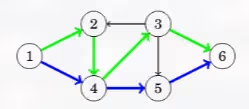
maximum flow assuming capacity of each edge is 1
Node-Disjoint Paths
every node appears in at most one path
split every node into 2 with a edge between the two parts that acts as the limiter
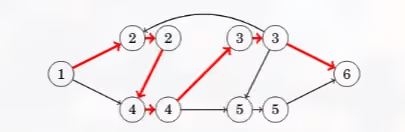
Maximum Matchings
Find a maximum-size set of node pairs in an undirected graph such that each pair is connected with an edge and each node belongs to at most one pair
Bipartite Matching
- add source and sink and find maximum flow = maximum matching
Hall's Theorem
Used to find out whether a bipartite graph has a matching that contains all left or right nodes. If the number of left and right nodes is the same, it tells us if it is possible to construct a perfect matching
- let be any set of left nodes and be the set of their neighbours
- a matching contains all left nodes only when
Konig's Theorem
maximum matching = minimum vertex cover for bipartite graph
minimum vertex cover = smallest vertice set to touch every edge
Edmond's Blossom Algorithm
Maximum Matching in general graph: https://www.youtube.com/watch?v=3roPs1Bvg1Q
https://web.stanford.edu/~rezab/classes/cme323/S16/projects_reports/shoemaker_vare.pdf
linked from