Limited Direct Execution
2026-11-18 · virtualisation
notes / Operating Systems / 01_vir
OS
Limited Direct Execution
- to virtualise the cpu and do stuff like timesharing and context switching whatnot, you need to be able to control the execution of a process
- can't just jump to
main() and be like idc what it does, be a strict parent. also important for security
- got to be efficient about this too, can't compromise performance
Directly Executing the Program:
| Create entry for process list |
|
| Allocate memory for program |
|
| Load program into memory |
|
Set up stack with argc/argv |
|
| Clear registers |
|
Execute call main() |
|
|
Run main() |
|
Execute return from main |
| Free memory of process |
|
| Remove from process list |
|
two problems with direct execution
- how to make sure program doesn't do some shit to mess up your laptop (linux moment)?
- how to implement time sharing? this doesn't allow for multiple processes
Problem #1: Restricted Operations and Security
introduce user mode and kernel mode
a user can never be trusted. it may try to hog your resources, or delete something important, or tons of other stuff. fuck the user. so we say if you want to do anything important, you have to go through the kernel. the kernel offers safe ways to do privileged things and can ensure the user does not overstep. fuck the user.
to do something privileged, the program executes a trap instruction to that:
- changes privilege to kernel mode
- performs the privileged operation under heavy supervision
- once done the kernel executes a
return-from-trap that changes the privilege back to user mode
- the process returns control to the user
gotta make sure kernel mode doesn't overwrite the context of user mode making return-from-trap impossible. x86 implements a kernel stack for each process to store the user context when entering trap
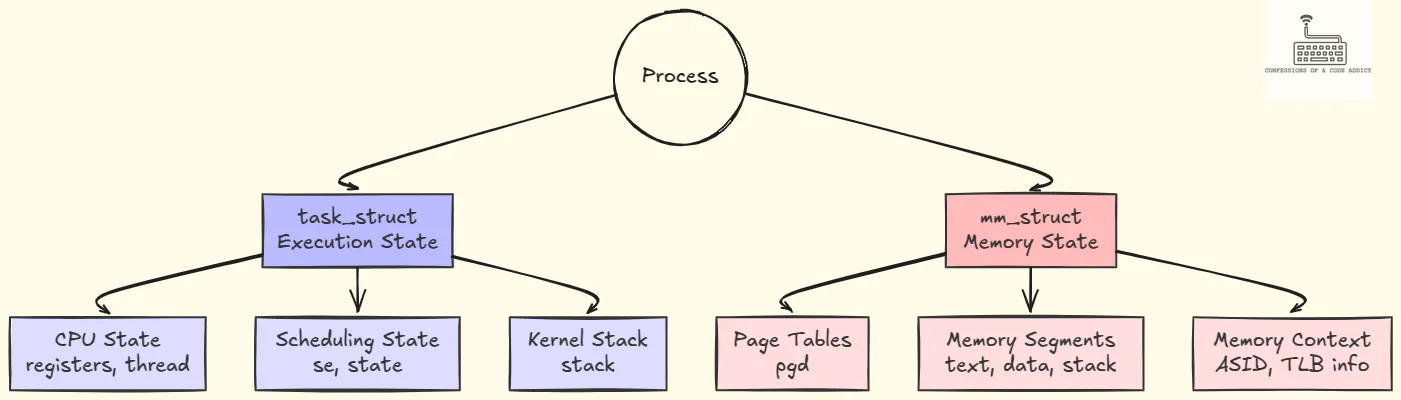
still gotta do this safely, the user must not have any sort of control over the kernel memory, so it can not be told the address of these syscalls, so it must call them other way. so the os defines some trap handlers which the hardware triggers when these traps are called, the hardware knows the exact address of these handlers, and the user only calls syscalls by their numbers, so user input can not call unsafe addresses
load the syscall number into rax and call the syscall instruction
main:
  mov %eax, 1 ; identifier for write() syscall
  syscall
man syscalls
info syscall
Userspace/Kernelspace Protocol
| initialize trap table |
remember address of syscall handler |
|
| Create entry for process list |
|
|
| Allocate memory for program |
|
|
| Load program into memory |
|
|
Setup user stack with argc/argv |
|
|
| Fill kernel stack with reg/PC |
|
|
| return-from-trap |
|
|
|
restore regs (from kernel stack) |
|
|
move to user mode |
|
|
jump to main |
|
|
|
run main() |
|
|
call sys call trap into OS |
|
save regs (to kernel stack) |
|
|
move to kernel mode |
|
|
jump to trap handler |
|
| handle trap |
|
|
| do work of syscall |
|
|
| return-from-trap |
|
|
|
restore regs (from kernel stack) |
|
|
move to user mode |
|
|
jump to PC after trap |
|
|
|
return from main() |
|
|
trap (via exit()) |
| Free memory of process |
|
|
| Remove from process list |
|
|
Some nice syscalls to remember
- process control:
- file management:
open()read()write()close()
- memory management:
- device management:
- communication:
pipe()socket()signal()kill()raise()
Problem #2: Time sharing and Switching Between Processes
if a process is running => the os is not running. so how does the os stop the process to start the next one?
wafadar(cooperative) approach
- trust the process will make syscalls at regular intervals
- syscalls give the os control back and then it can choose to run a diff process
- such systems usually include an explicit
yield() syscall
- overly trusting. remember, fuck the user
bewafa(non-cooperative) approach
- don't trust the process. maintain a timer and regain control every few miliseconds
- it chooses to switch processes or not based on the scheduler
- if it chooses to switch, then it executes the context switch. reminder context is basically the state of the registers at that moment for the process
- it saves the
- general purpose registers
- pc
- kernel sp
- and restores the same of the process it is switching to
- this is expensive though
Limited Direct Execution Protocol (with timer interrupt)
| initialize trap table |
remember address of syscall handler |
|
| start interrupt timer |
start timer |
|
|
interrupt CPU in X ms |
|
|
|
Process A |
|
|
... |
|
timer interrupt |
|
|
save regs(A) -> k-stack(A) |
|
|
move to kernel mode |
|
|
jump to trap handler |
|
| handle the trap |
|
|
call switch() routine
- saves regs(A) -> proc_t(A)
- restores regs(B) <- proc_t(B)
- switch to k-stack(B)
|
|
|
| return-from-trap (into B) |
|
|
|
restore regs(B)<--k-stack(B) |
|
|
move to user mode |
|
|
jump to B's PC |
|
|
|
Process B |
|
|
... |
; void swtch(struct context *old, struct context *new);
;
; Save current register context in old
; and then load register context from new.
.globl swtch
swtch:
    ; Save old registers
    movl 4(%esp), %eax       ; put old ptr into eax
    popl 0(%eax)             ; save the old IP
    movl %esp, 4(%eax)       ; and stack
    movl %ebx, 8(%eax)       ; and other registers
    movl %ecx, 12(%eax)
    movl %edx, 16(%eax)
    movl %esi, 20(%eax)
    movl %edi, 24(%eax)
    movl %ebp, 28(%eax)

    ; Load new registers
    movl 4(%esp), %eax       ; put new ptr into eax
    movl 28(%eax), %ebp      ; restore other registers
    movl 24(%eax), %edi
    movl 20(%eax), %esi
    movl 16(%eax), %edx
    movl 12(%eax), %ecx
    movl 8(%eax), %ebx
    movl 4(%eax), %esp       ; stack is switched here
    pushl 0(%eax)            ; return addr put in place
    ret                      ; finally return into new ctxt
Measuring the Context Switch
vmstat:
- virtual memory stats, lets you measure number of context switches and other process statistics
❯ vmstat 1 3     # fetch stats every second for 3 seconds
procs -----------memory---------- ---swap-- -----io---- -system-- -------cpu-------
 r  b   swpd   free   buff  cache   si   so    bi    bo   in   cs us sy id wa st gu
 2  0      0 10536812 144984 2512216 0    0   308   229 2791    1  1  1 99  0  0  0
 1  0      0 10535536 144984 2512220 0    0     0    60 6067 5297  7  1 92  0  0  0
 1  0      0 10535076 144984 2512220 0    0     0    60 5721 5096  7  1 92  0  0  0
important things are
r ready processesb blocked processesin interrupts in the intervalcs context switches in the intervalus %time spent running user codesy %time spent running kernel codeid %idle timewa %waiting for io
/proc/<pid>/status:
- status information of any running process includes the number of context switches
❯ cat /proc/1876/status
Name:   librewolf
State:  S (sleeping)
Pid:    1876
PPid:   1605
Threads:    139
...
voluntary_ctxt_switches:    602289
nonvoluntary_ctxt_switches: 29170
The Effect of Context Switches on cache performance